Infrastructure & cybersecurity
Secure architectures, Zero Trust, DevSecOps, monitoring and continuity for sensitive environments.
In short: Security is not a bolted-on layer: it structures the architecture.
See infrastructure →Systèmes critiques, autonomie, cybersecurity et communications sécurisées.
Missions critiques, deployments contraints, sovereignty numérique et fonctionnement en mode dégradé: nous let's build des systèmes robustes, observables et maintenables in the field.
In secure civilian as in defense contexts, failure is not an operational option. Systems must withstand outages, hostile conditions, intrusion attempts, and rapid-deployment constraints. Documentation, traceability, and the ability to operate in degraded mode are part of the product.
We design defense-ready architectures: security by design, segmentation, observability, local autonomy, and recovery procedures. The civilian → defense continuum lets us reuse proven building blocks while respecting each mission’s specifics.
Infrastructure, cybersecurity, embedded, AI and operations: a chain designed for constraint.
Secure architectures, Zero Trust, DevSecOps, monitoring and continuity for sensitive environments.
Edge, robotics, drones and autonomous platforms for surveillance, inspection and mission support.
See embedded →AI infrastructure, RAG, agents and embedded vision for decision support and stream processing.
See AI →Business applications, mapping, command interfaces and secure APIs.
See development →Private cloud, dedicated environments, and container platforms under operational control.
See hosting →DRP/BCP, monitoring, and operational sustainment of critical systems.
See continuity →Robotics and sensor-fusion building blocks designed for inspection, surveillance, logistics and operations in constrained environments.
Development of autonomous or teleoperated ground platforms for inspection, logistics, security, mapping or missions in constrained environments.
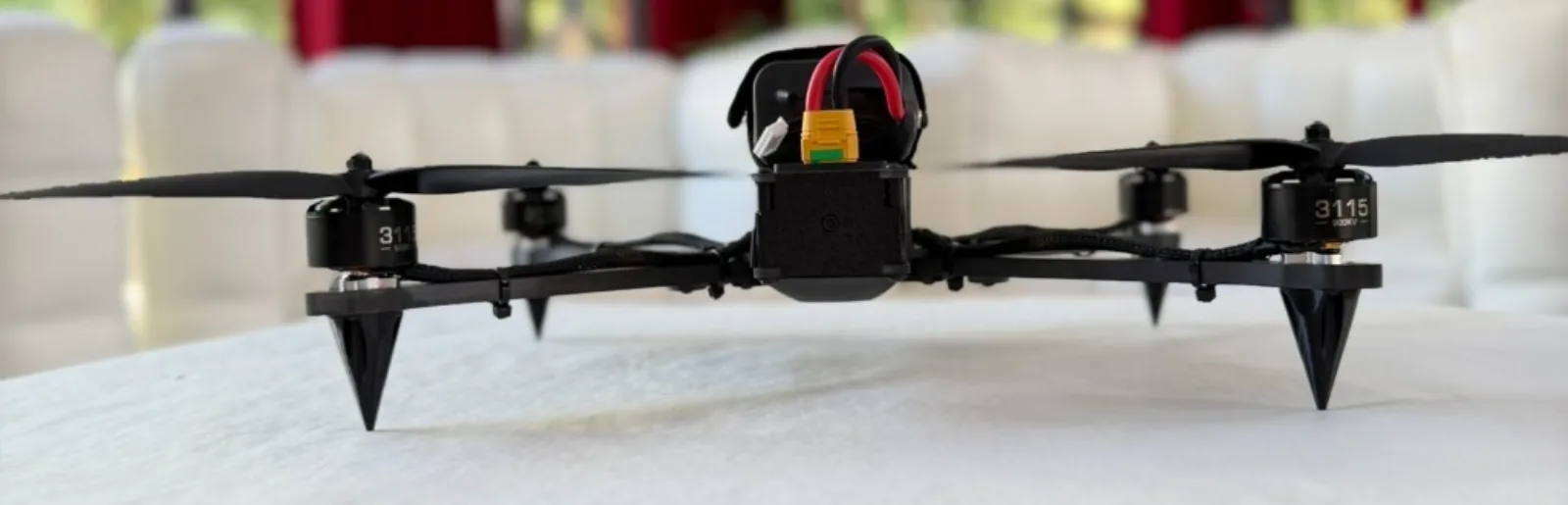
Drone design, integration of flight computers, payloads, communication systems, control stations, telemetry, video, and advanced assistance or autonomy features.
Development of surface or underwater vehicles integrating navigation, telecommunications, video, sonar, environmental sensors and remote monitoring.
Integration of optical, thermal, inertial, radar, environmental or industrial sensors with synchronization, calibration, data fusion and local or remote processing.
We advance by evidence: architecture, constrained prototyping, hardening, then documented operations.
Operational constraints, threats, classification, deployment environment, and acceptance criteria.
Decomposition, attack surfaces, resilience, technology choices, and compliance plan.
Validation in realistic conditions, load tests, degraded scenarios and field feedback.
System hardening, controlled CI/CD, documentation, training, and operating procedures.
Monitoring, operational sustainment (MCO), vulnerability management, and controlled capacity evolution.
Let’s discuss the mission, constraints and expected sovereignty level. We propose a suitable technical and operational trajectory.